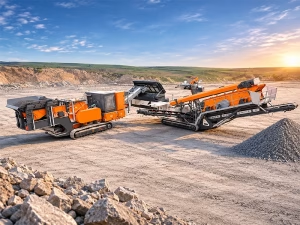
Site efficiency with tracked crushers is not created by crushing speed alone. The larger operational benefit can come from moving the crusher closer to the material, reducing internal haulage, repositioning equipment as the work face changes and organising the crushing and screening flow around the site.
For this reason, tonnes per hour should be evaluated together with truck movement, material rehandling, setup requirements and how often the production point changes.
Polygonmach’s tracked crushing and screening range includes jaw, cone, impact, VSI and screening equipment for mobile processing applications.
How Can Tracked Crushers Reduce Internal Material Transport?
With a fixed crushing point, material normally needs to travel to the same plant throughout the operation. As the active face moves farther away, truck and loader routes can become longer and material handling can represent a growing part of site activity.
Where conditions allow, a tracked crusher can be repositioned closer to the material source.
What Happens When the Crusher Moves Closer to the Feed?
Shorter distances may help:
- reduce some truck and loader movement,
- limit repeated material handling,
- improve coordination between extraction and crushing,
- change the amount of intermediate stockpiling required.
The scale of the benefit depends on the site.
On a compact operation with a stable feed point, mobility may create limited improvement. On a large site with an advancing production face, the effect can be much more significant.
What Happens as the Working Face Changes?
In quarrying and mining, the location of active material can move over time.
Repositioning tracked equipment with the working face can reduce the need to create new fixed processing points.
This can make site planning more flexible, particularly on phased or temporary projects.
How Should Crushing, Screening and Stockpiling Be Balanced?
A tracked crusher can produce quickly, but site efficiency will not improve if downstream screening or stockpiling cannot handle the output.
The same process principle applies to mobile equipment as to stationary plants: feeding, crushing, screening and conveying capacities need to be balanced.
When Does Integrated Equipment Help?
Some tracked configurations can include final screens, recirculating systems or integrated conveyors.
Where required by the process, these features can help:
- classify material within the same equipment group,
- return oversize material for further crushing,
- reduce the number of separate machines,
- create more organised stockpiles.
Maximum integration is not always necessary.
Adding equipment that the project does not require can increase weight, complexity and investment without improving actual production.
Why Do Stockpile and Conveyor Layouts Matter?
If finished material accumulates around the crusher, another bottleneck can develop.
Conveyor direction, stockpile height, loader access and separation of product fractions should therefore be included in the site layout.
The key question is not only how material enters the crusher, but also where it goes after leaving the machine.
How Do Maintenance and Operational Management Affect Site Efficiency?
Mobility can save time in setup and material handling, but those gains can be lost if maintenance results in repeated unplanned shutdowns.
Tracked equipment includes not only the crusher but also the undercarriage, feeders, conveyors, hydraulics and power systems.
Why Is Planned Maintenance Important?
Mobile equipment can encounter changing dust, ground and feed conditions as it moves between working areas.
Routine inspection can include:
- crusher wear components,
- crawler undercarriage,
- conveyor belts,
- hydraulic systems,
- lubrication points,
- screens and feeders.
Planned maintenance is not only about preventing failure. It also helps preserve consistent production.
Which Data Shows Real Site Efficiency?
Crusher tonnage alone does not provide the full picture.
Useful site indicators can include:
- hourly production,
- equipment operating time,
- relocation time,
- fuel or energy use,
- haul distance,
- loader and truck operating hours,
- unplanned downtime.
Looking at these values together helps show whether the tracked system is creating value through crushing performance, logistics improvement or both.
Frequently Asked Questions About Tracked Crusher Efficiency
Do tracked crushers eliminate the need for haul trucks?
Usually not, but moving the crusher closer to the material can reduce some internal transport requirements.
How often should a tracked crusher be relocated?
There is no fixed interval. Relocation should depend on the work face, material distance and safe site organisation.
Does an integrated screen always improve efficiency?
Only when it supports the required process and final product specification.
How should site efficiency be measured?
Throughput should be considered together with haul distance, downtime, energy use and the operating time of supporting site equipment.
Optimise the Site Flow, Not Just the Crusher
The strongest benefit of tracked crushing often comes from the ability to manage the processing point together with material movement and site logistics.
Share your current site layout, haul distances and target production through the Polygonmach contact page to evaluate how a tracked configuration could simplify the operation. You can also review the wider crushing and screening range for complementary equipment.